
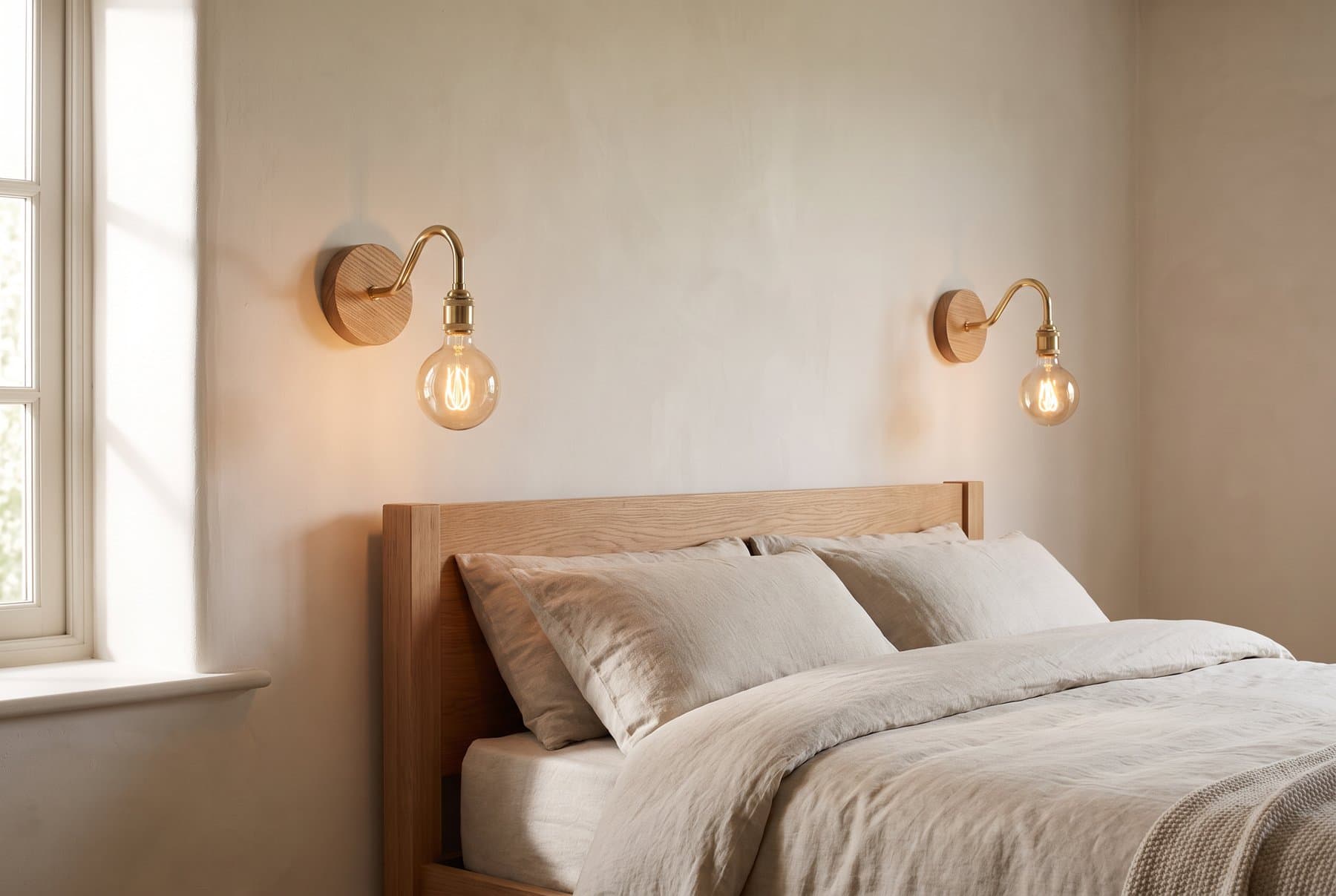
The short answer: fit a bedside wall light so the centre of the back plate is 1.2 to 1.4 metres from the floor, and set it 15 to 25 cm outside the edge of the mattress. That puts the light at shoulder height when you are sitting up, and on the page rather than in your eyes. The rest of this article is why, and what changes with your bed, your ceiling and the shape of the light.
Why the number is a band, not a height
Every guide gives a different figure because the right height depends on three things that vary from bedroom to bedroom: how high the mattress top is, how tall the people in the bed are, and whether the light points down at you or out into the room. A divan with a deep mattress can put the top at 70 cm; a low platform bed can be 40 cm. Ten centimetres of mattress is ten centimetres of wall light.
So measure from your own mattress rather than from the floor. Sit up in bed as you would to read, and note where your shoulder is. That is where the plate goes. For most people on most beds it lands between 1.2 and 1.4 m, which is why that band keeps turning up — but it is your shoulder that decides, not the average.
How far from the edge of the bed
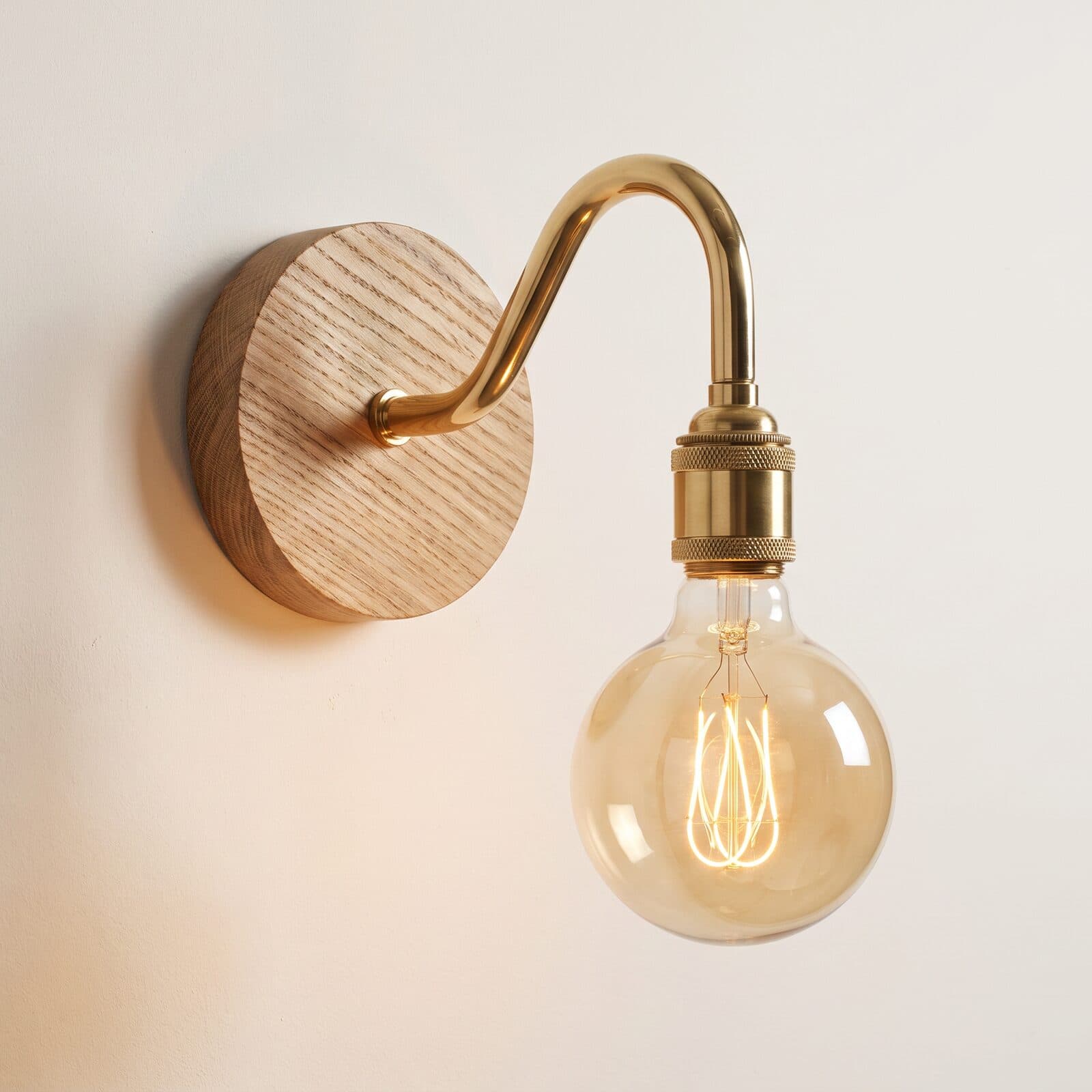
Horizontally, the light wants to sit just outside the mattress so the bulb hangs over the pillow without you hitting the arm when you get in. With a flat, flush wall light that means the fitting itself goes roughly above the edge of the mattress. With a swan neck it is different, and this is the bit most guides get wrong: the arm reaches 28 cm out from the wall (30–34 cm with a bulb in), so the plate can sit 15–25 cm outside the mattress and the bulb still ends up over the pillow. The plate stays clear of the headboard; the light does not.
If there is a headboard, check its height first. A tall upholstered headboard of 1.2 m or more will sit behind where the plate would go, so either fit the light above it — which pushes the height up towards 1.5 m and turns it into an ambient light rather than a reading light — or move it outboard of the headboard entirely. A swan neck copes with the second option better than anything flush, because the arm carries the light back over the bed.
One light or two
Two if two people sleep there. The whole point of a wall light beside the bed is that one of you can read while the other sleeps, and that only works if each side has its own light on its own switch. A single light in the middle above the headboard looks tidy in a showroom and lights the wrong place for both of you.
A single bed, or a double pushed against a wall, wants one light on the open side. In a child’s room, one is plenty and it can go a touch lower, since the person reading is shorter.
If you are buying a pair, buy them together. Made-to-order lights with solid timber plates vary slightly in grain from one to the next, and a pair cut from the same batch will match more closely than two ordered a month apart. (That is true of ours, and it is true of anyone’s who turns the plate rather than pressing it.)
Where the switch goes
Decide this before anyone plasters. The comfortable arrangement is a switch beside each side of the bed, low enough to reach without sitting up, with each light on its own. If the room is already finished and there is one existing switch by the door, the usual compromise is a two-way circuit: the door switch and a second switch by the bed, either of which works the lights. A good electrician will do this as a matter of course; it is worth asking for it by name.
The other answer, if running new cable is not on, is a plug-in wall light with an inline switch on the flex — no electrician, and the switch is wherever the flex is.
Which bulb
A reading light wants to be bright enough for a page and dim enough not to wake anyone. In practice that is a 4–6 W LED filament bulb, warm white (2200–2700 K), about 400–470 lumens. Go dimmable if the circuit has a dimmer, and if the bulb is on show — as it is on any exposed-bulb light — choose a globe shape rather than a standard pear, because the bulb is half the look. There is a separate article on which globe size suits which fitting.
The mistakes worth avoiding
- Fitting to the ceiling height instead of the bed. A tall room does not need a higher light; it needs the same light and a longer stretch of empty wall above it.
- Centring the light on the bedside table. The table moves; the pillow does not. Centre on where your head is.
- One light for two people. Covered above. It is the single most common reason people end up buying bedside lamps to go with the wall lights they just fitted.
- An up-facing bulb. A light that throws upward lights the ceiling and leaves the book in shadow. For reading, the bulb wants to point at the bed.
In one line
Plate centre at your seated shoulder height — usually 1.2–1.4 m — 15 to 25 cm outside the mattress edge, one each side, each on its own switch, with a warm dimmable globe. If you want to see what that looks like in brass, black or copper on oak, beech or walnut, the bedside wall lights page has every combination.