
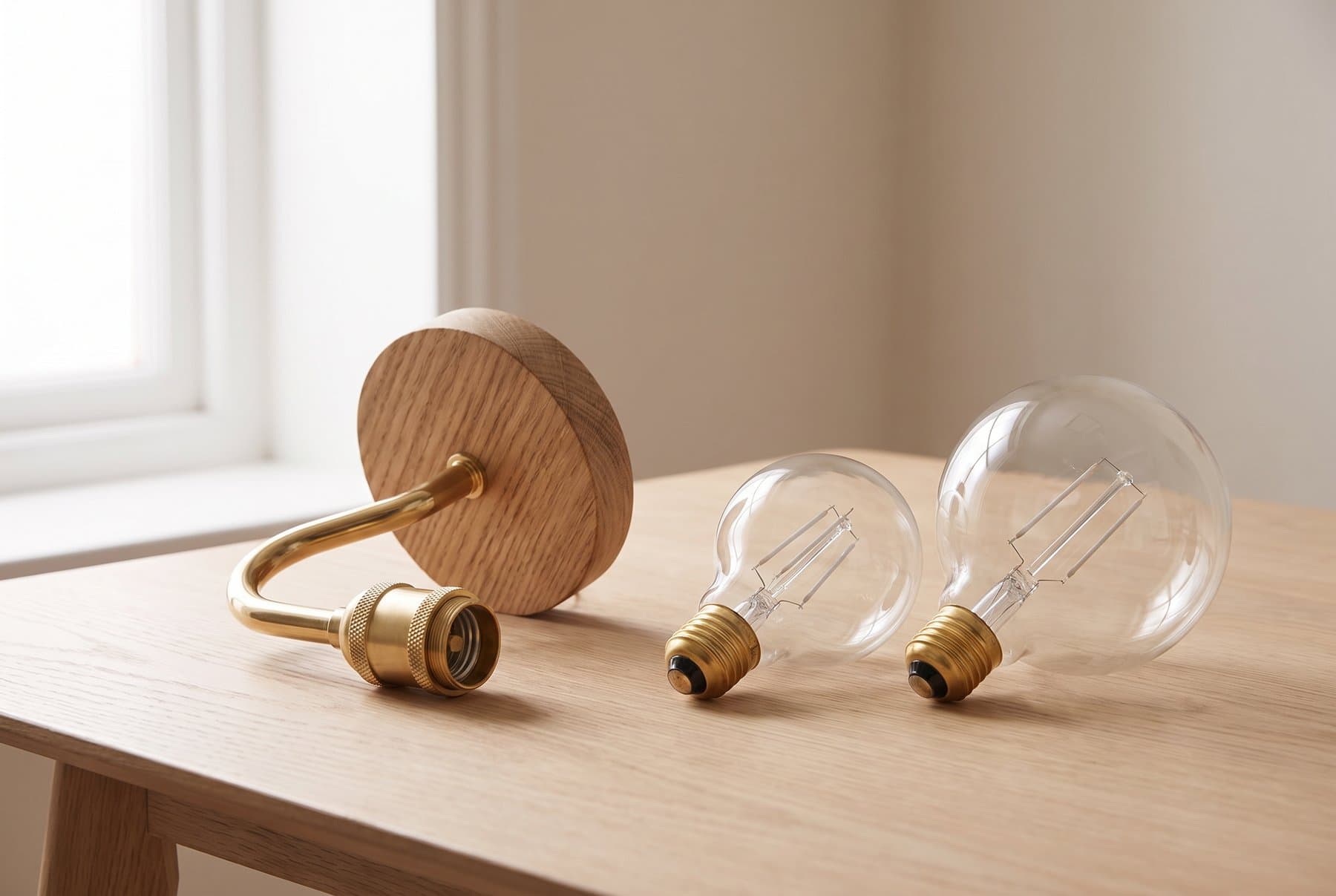
On a light with an exposed bulb, the bulb is half the fitting. Choose the wrong one and a good wall light looks like a bare socket; choose well and the bulb becomes the thing people comment on. The codes on the box — E27, G95, G125, A60 — are not as obscure as they look, and once they are decoded the choice is a short one.
The codes, decoded
There are two separate things on a bulb box and they are easy to mix up. The first is the cap, the bit that goes into the fitting. The second is the shape, the bit you look at.
- E27 is a cap: an Edison screw 27 mm across, the large screw fitting used across Europe and by most exposed-bulb lights, including ours. You will also see it called ES. It is not a size of bulb, which is why “E27 bulb size” gets searched so much and answered so badly. (E14 is the small screw; B22 is the UK bayonet.)
- A60 is a shape: the standard pear-shaped household bulb, 60 mm across at its widest. It is what most people picture when they picture a bulb, and it is the wrong one for an exposed holder, because it looks like exactly that — a household bulb with nowhere to hide.
- G95 is a globe 95 mm in diameter. Nearly a sphere, about the size of a cricket ball.
- G125 is a globe 125 mm across — the large one, roughly a grapefruit. There are G80 (80 mm) globes too, and a few G150 if you go looking.
So the bulb for our wall light is “E27 G95” or “E27 G125”: a screw cap, and a globe of one size or the other. Both are stocked by every big shed and most supermarkets in LED filament form, usually between £4 and £12.
G95 or G125: which suits the fitting
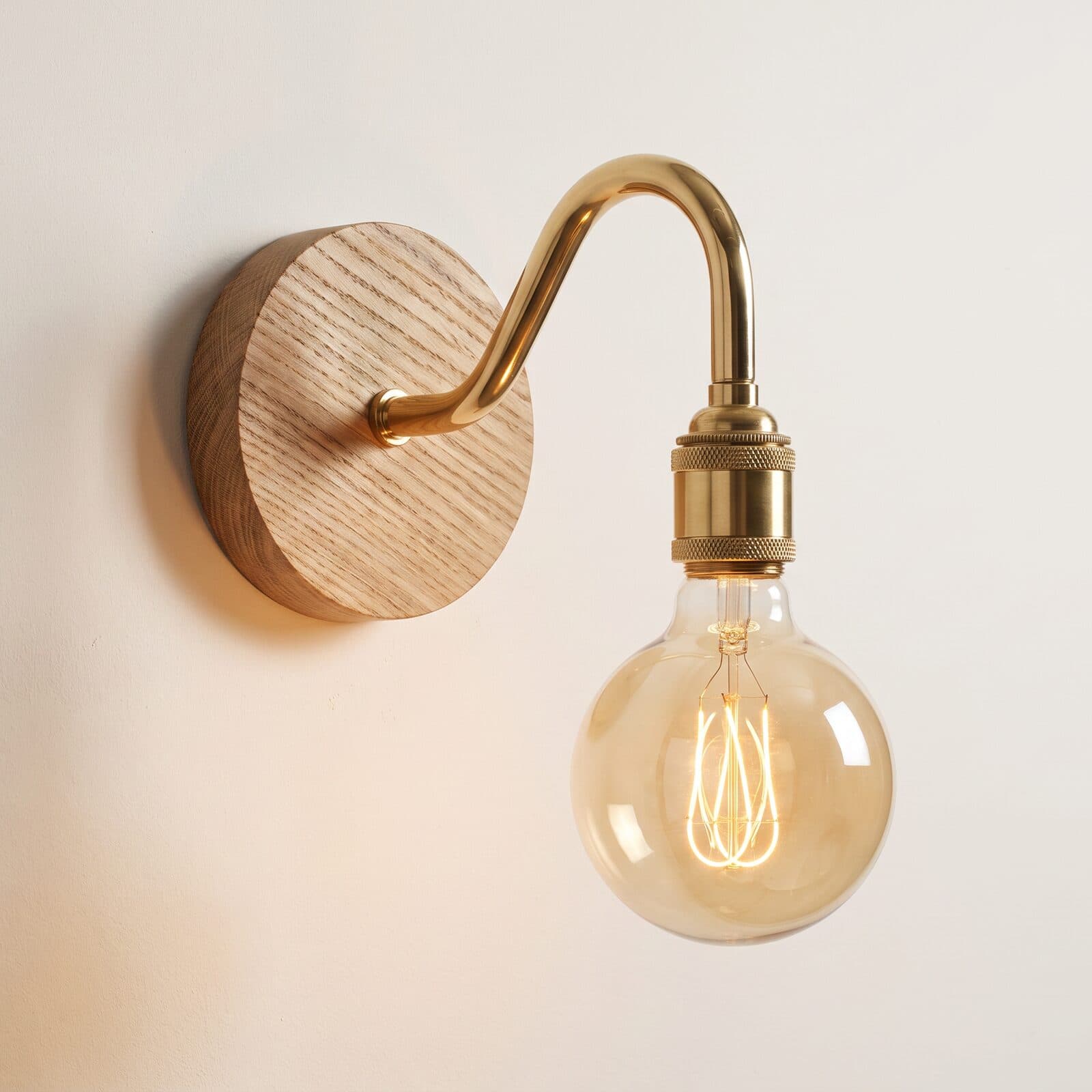
The honest answer is that it is a proportion question, and you decide it against the back plate. Ours is 14 cm across. A G125 is 12.5 cm across, so the bulb and the plate are visually the same size — a confident, balanced look where the bulb reads as the “shade” and the plate as its base. A G95 is noticeably smaller than the plate, which is quieter and makes the arm and the wood the main event.
There is also the practical difference: reach. The arm projects 28 cm from the wall on its own, and the bulb, hanging from the holder at its tip, adds to that. With a bulb fitted the light stands 30–34 cm off the wall — the smaller figure with a G95, the larger with a G125. In a narrow hallway those few centimetres matter; beside a bed they do not.
Our rule of thumb: G125 in a bedroom or living room where the light is a feature and there is space around it; G95 in a hall, a landing, above a mirror, or anywhere two or three lights sit in a row and a grapefruit each would be a lot. If you cannot decide, buy one of each — they are cheap — and hold them up to the fitting before you commit.
Clear, smoked or frosted
Clear shows the filament, which is the whole point of a filament bulb, and gives the sharpest light and the crispest shadows. It is what we photograph and what suits brass and copper best, because the metal catches the filament. Smoked or amber glass warms the light further and takes the glare down a notch; it is the one to pick if the bulb is at eye level in a hall. Frosted or opal hides the filament and gives an even glow — softer, more like a shade, and the right choice if the bulb will be in your eyeline in bed and you find a bare filament harsh.
How bright, how warm
Filament LEDs are less bright than they look, and that is generally the idea. For a bedside light or a hall, 400–470 lumens — the “40 W equivalent”, around 4 W of actual LED — is plenty and is where most G95s sit. Big G125s go up to 6–8 W and 800 lumens, which is a proper room light; pair two of those either side of a bed and you will want a dimmer.
Colour temperature is on the box in kelvin. 2700 K is ordinary warm white. 2200 K is the amber, candle-ish tone that filament bulbs are bought for, and is the better choice in a bedroom. Anything 3000 K and above starts to look like an office, and 4000 K is a mistake on a brass fitting. If the box just says “warm white”, it is probably 2700 K.
The dimmer catch
Two things nobody tells you until the bulb flickers. First, a bulb must say dimmable to be dimmed; a non-dimmable LED on a dimmer will buzz, strobe or die. Second, the dimmer itself matters: old dimmers designed for halogen and incandescent bulbs (leading-edge) do not get on with LED. What you want is a trailing-edge LED dimmer, and it needs a minimum load it can work with — two 4 W bulbs is 8 W, and some dimmers will not go that low. Check the dimmer’s minimum wattage against the bulbs you are buying before you fit either.
If it is only a bedside light and you would rather not deal with any of that, a single 2200 K G95 at 4 W on an ordinary switch is dim enough to read by and not wake anyone, and there is nothing to go wrong.
What we would buy
For a pair of bedside wall lights: clear or lightly smoked G125, E27, 2200 K, 4–6 W, dimmable, on a trailing-edge dimmer. For a run of three in a hallway: clear G95, 2700 K, 4 W, on one switch. In both cases buy a spare — filament LEDs last years, but not forever, and a fitting that shows its bulb shows its missing bulb just as clearly.
The light does not come with a bulb, deliberately: the choice above is yours to make, and it costs a lot less to make at a shop than for us to guess and post you the wrong one. Everything about the light itself is on the product page.