

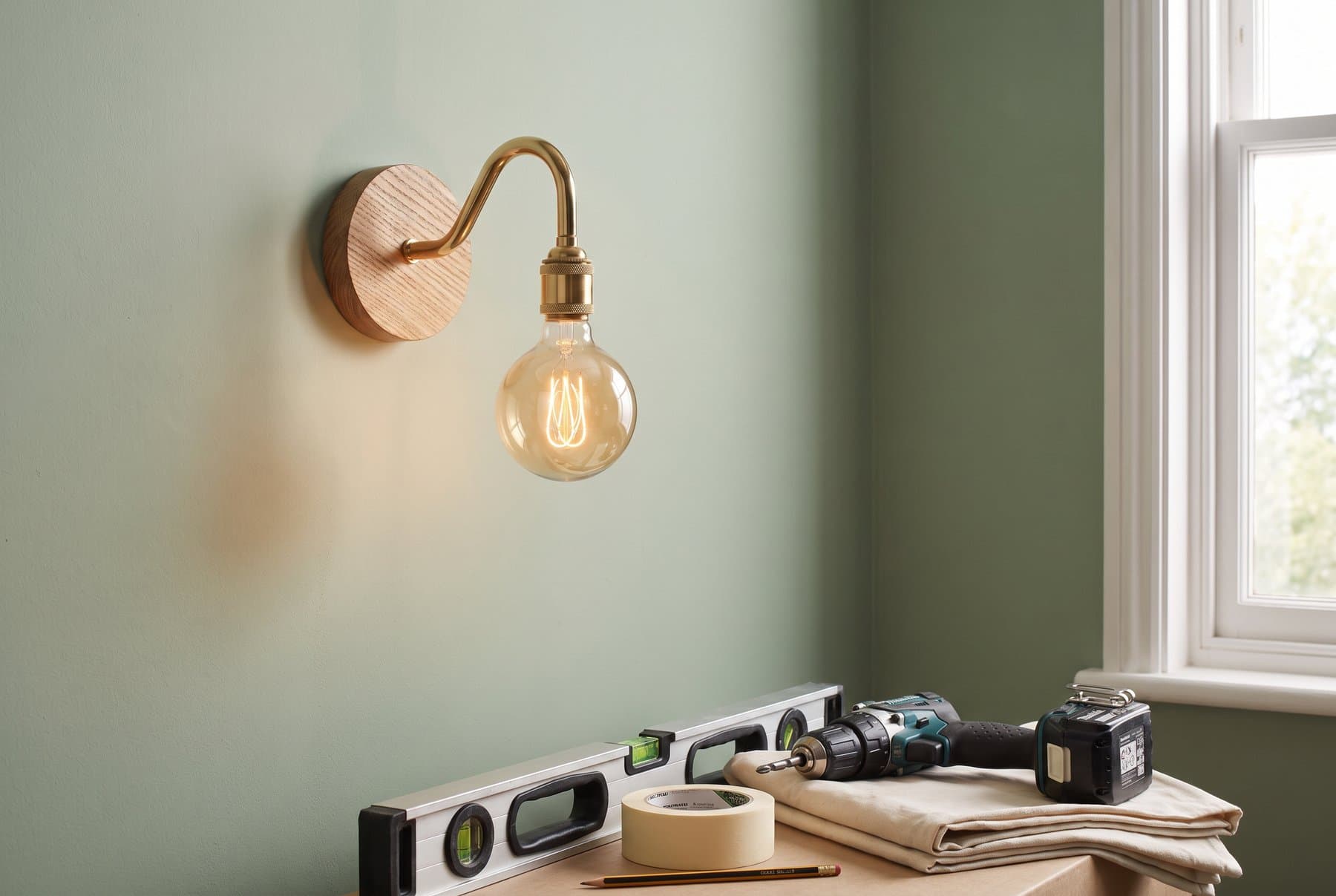
Fitting a wall light is one of those jobs that is either forty minutes or a day and a half, and which one you get depends entirely on whether there is already a cable in the wall. This article walks through both cases honestly, explains what the UK rules actually say about doing it yourself, and ends with the option that needs no electrician at all.
A word first. A wall light is a mains fitting. Nothing here is a substitute for a qualified electrician, and if you are not confident testing a circuit dead, stop at the planning stage and book one. The good news is that a wall light is a small job for a professional — typically an hour or two per pair with existing wiring — and the money is better spent there than on a second-hand story about what happened next.
Case one: there is already a wall light (or a cable) there
This is the easy one. If you are replacing an old wall light, or the house was wired with a cable left in the wall for one, the circuit already exists and all you are doing is connecting a new fitting to it.
- Isolate the circuit. Switch off the lighting circuit at the consumer unit — the breaker, not just the wall switch — and put a note on it so nobody switches it back on. Then prove it is dead with a voltage tester at the cable itself. Every electrician does this every time; do it every time.
- Take the old fitting off and look at the cable. UK lighting cable is usually 1.0 or 1.5 mm² twin-and-earth: brown (live), blue (neutral) and a bare copper earth, which should be sleeved in green-and-yellow. Older houses may have red and black — same job, older colours. If you find two cables rather than one, the wall light is being looped through; note carefully which is which before you disconnect anything.
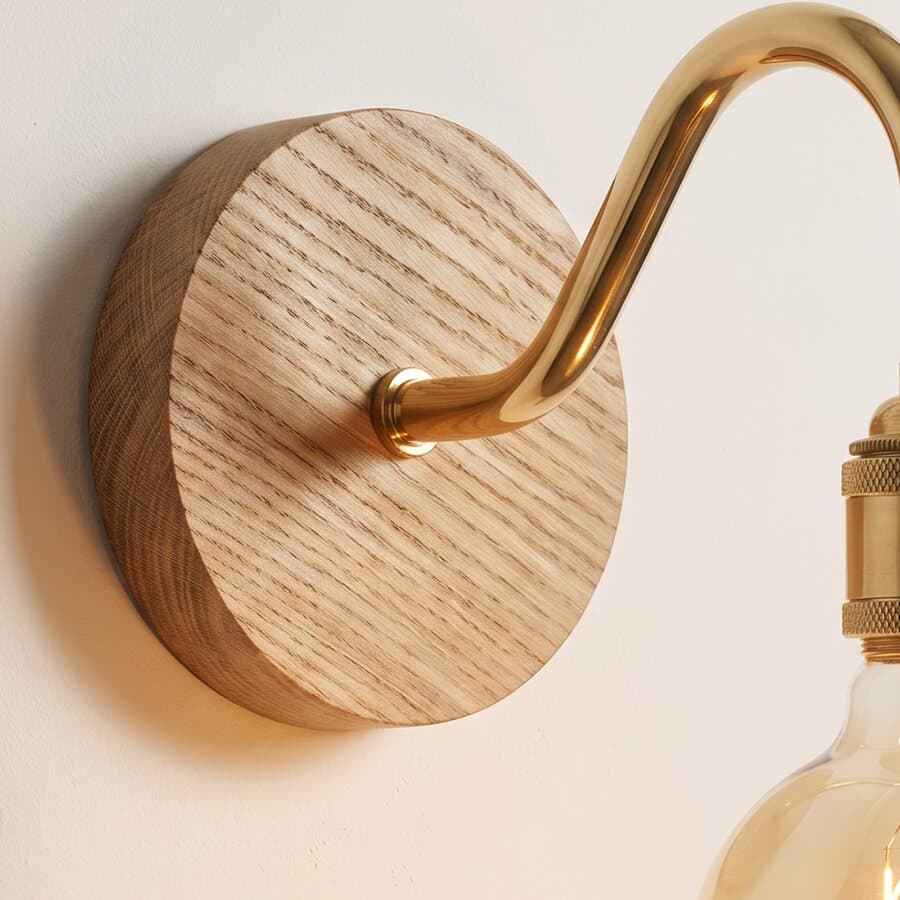
- Fix the back plate. The cable comes through the middle of the plate. Mark the fixing holes, drill and plug the wall — a 14 cm plate on a solid wall usually takes two fixings; on plasterboard use proper plasterboard fixings, not bare screws. Check it is level before you tighten, because a swan neck makes a one-degree lean very obvious.
- Connect it. Brown to L, blue to N, earth to the earth terminal. Any fitting with exposed metal — and a brass or chrome arm is exposed metal — must be earthed. Make the connections tight, with no bare copper showing outside the terminal.
- Fit the bulb, restore the power, test. Turn the breaker back on, then the switch. If nothing happens, isolate again before you touch it.
If this reads as straightforward, it is — for someone who has done it. The reason to still consider an electrician is that steps one and four are where people get hurt, and you cannot tell from outside whether the loop-in wiring in an older house is doing something unexpected.
Case two: there is no wiring where you want the light
This is the day-and-a-half. A new wall light where nothing has been before means a new cable run from the nearest point on the lighting circuit — usually the ceiling rose or the existing switch — to the new position, and a switch to control it.
There are two ways to get the cable there. Surface: in trunking or mini-conduit on the wall, which is quick and reversible and looks exactly like what it is. Chased in: cut into the plaster, cable in capping or conduit, then filled and redecorated. The second is the only one most people are happy to look at, and it is why wall lights are best planned when a room is being decorated anyway.
In a solid wall the chase has to run vertically or horizontally from the fitting — never diagonally — in the “safe zones” the regulations define, so that anyone drilling that wall later can predict where the cable is. In a stud wall the cable can often be dropped down inside the cavity from above with far less mess.
This is the job to hand to an electrician. Not because it is beyond a careful person, but because it is slow, dusty and — for the reason below — better done by someone who can certify it.
What Part P means for you
In England and Wales, electrical work in homes is covered by Part P of the Building Regulations. The rule, simplified, is this: adding a new light to an existing circuit in an ordinary room — a bedroom, a hallway, a living room — is not notifiable, so you may do it yourself provided it is done to the wiring standard (BS 7671). Work in a bathroom, or adding a whole new circuit from the consumer unit, is notifiable and must be either done by a registered electrician or inspected by building control.
So a pair of bedside wall lights spurred off the bedroom lighting circuit is legally yours to do. Whether it is wise depends on whether you can test dead, wire to the standard and connect into the existing circuit without disturbing it. Scotland has its own rules under the Building Standards system, and they are stricter; check before you start.
The option with no electrician: plug-in
If none of the above appeals — you rent, the walls are freshly decorated, or the nearest cable is on the other side of the house — there is a third way that fits half the searches on this subject and rarely gets mentioned. A plug-in wall light is the same fitting with a length of fabric flex, an inline switch and a 13-amp plug. It screws to the wall like any other; the flex drops to a socket. No circuit, no chase, no certificate, and it comes with you when you move.
The compromise is the visible flex, and the trick is to make it deliberate: a twisted fabric flex in black or a colour, dropping straight down to the skirting, reads as a design choice in a way that white PVC never does. If you would like ours as a plug-in, ask — we are looking at offering it, and the answer at the moment is a conversation rather than a listing.
Before you drill: the checklist
- Height and position decided. For a bedside light that is 1.2–1.4 m to the plate centre; there is a whole article on why. For a hallway it is 1.5–1.7 m.
- Cable and pipe check. Run a detector over the wall before drilling. Cables should be in safe zones; pipes are wherever the plumber felt like putting them.
- Right fixings for the wall. Brick and block take plugs; plasterboard takes plasterboard fixings; a stud behind the plasterboard is best of all if you can find one where you want it.
- The bulb bought already. Most made-to-order lights, including ours, come without one. You want a warm, dimmable E27 globe; the size question is here.
- An electrician’s number, even if you plan to do it yourself. The moment you find something you did not expect is not the moment to start searching for one.
In one line
Existing cable: isolate, prove dead, plate on level, brown-blue-earth, test — forty minutes. No cable: plan the run, chase or trunk it, and pay someone. Neither: plug-in. Whichever it is, the light on the wall is the part that lasts, and that is the part we make.